
A Birthday Like No Other
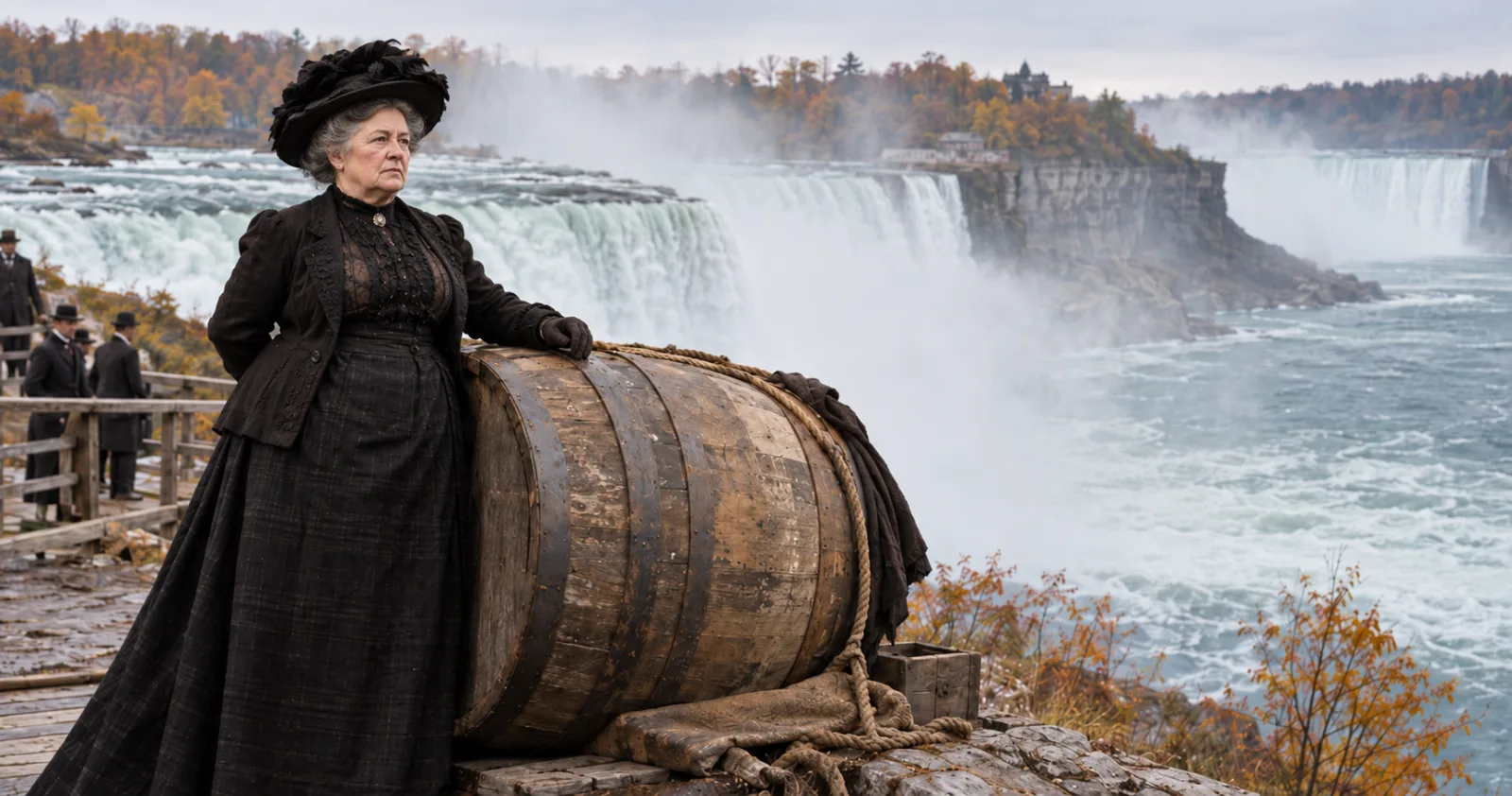
On Thursday, October 24, 1901, Annie Edson Taylor turned 63. She celebrated by climbing into a wooden barrel on the Niagara River and riding it over the Horseshoe Falls.
Nobody had ever gone over the falls in a barrel and lived. By the end of that afternoon, a widowed schoolteacher with a lucky heart-shaped pillow had done it, and she'd done it on her birthday.
Saturday, October 24, 2026, marks 125 years since that ride. It's one of the wildest stories this region has, and the real version is better, and sadder, than the legend.
Who Annie Was
Annie Edson was born on October 24, 1838, in Auburn, a Finger Lakes girl and one of eight kids. Her father owned a flour mill. He died when she was 12, but he left enough for the family to live comfortably for a while.
She trained as a teacher and met David Taylor while she was studying. They married and had a son, who died as a baby. Not long after, her husband died, too.
After that, Annie kept moving. She drifted between jobs and towns for years. She opened her own dance school in Bay City, Michigan, because there wasn't one there. She taught music in Sault Ste. Marie in 1900, went to San Antonio, and then tried Mexico City with a friend, looking for work. None of it stuck, and she ended up back in Bay City.
By 1900 things had gotten bad. She'd been burned out of her home and lost money she'd invested with a clergyman. She also started shaving years off her age, figuring a younger woman would have an easier time making money. She claimed to be just 42, and on the 1900 census she listed her birth year as 1860. She was actually in her early 60s.
Why Niagara, and Why 1901
In 1901, everybody seemed to be headed to Western New York. The Pan-American Exposition was running in Buffalo, drawing visitors from all over the world, and many of them took the train up to see the falls. During the expo, somewhere between 10,000 and 50,000 people a day were visiting Niagara Falls Reservation State Park, created in 1885 as the oldest state park in the country.
Annie wanted their attention. People were already riding barrels through the whirlpool rapids below the falls and getting cheered for it. Nobody had gone over the falls themselves. She decided she'd be the first, and that it would set her up for the rest of her life.
She had a barrel built to her own design from oak and iron. Inside went a mattress, cushions, pillows and a harness, and there was a tube so air could be pumped in once the lid was sealed.
The hard part was finding anybody to help. Nobody wanted to be part of what most people figured was a suicide, and the launch kept getting pushed back. In the days before her attempt, the barrel went over the Horseshoe Falls with a cat inside as a test. The cat came out with a bleeding head, but alive, and later posed for photos with Annie.
Port Day, Thursday Afternoon
On her birthday, Annie set out with two assistants, William Holleran and Fred Truesdale, to Port Day on the American side of the river, above the rapids that lead to the Horseshoe Falls. She'd announced what she was going to do, and a crowd had gathered on shore to watch.
She'd changed into something comfortable for the trip, a lightweight blue skirt and a blue blouse. She climbed into the barrel with her heart-shaped pillow. The lid was screwed down. Her helpers used a bicycle tire pump to push air into the barrel, then plugged the hole with a cork.
The men rowed out with the barrel in tow, then cut the rope. It was set adrift near the American shore, south of Goat Island, and the current did the rest. The river carried Annie toward the Canadian Horseshoe Falls and over the edge, a drop of about 167 feet.
The whole trip, from the moment she was cut loose to the bottom of the falls, took less than 20 minutes.
"Annie Is Alive"
Men waiting below dragged the battered barrel to the Canadian shore. It was a while before they actually got it open. When they did, Annie was alive. She had a small gash on her head and some cuts and bruises, and that was about it.
The man who helped her out of the barrel was her friend Carlisle Graham, the first person to run the Niagara rapids in a barrel. She came out stumbling and was taken back to the American side for medical treatment.
She'd done what nobody else had done. She also had no interest in ever doing it again. She told reporters she'd rather "walk up to the mouth of a cannon" than make another trip over the falls, and she warned everyone else against trying it.
Fame, but No Fortune
For a little while, Annie was a celebrity. She showed up on the last day of the Pan-American Exposition, November 1, as the headlines were still flying. She went on the lecture circuit and wrote a memoir.
The money never really came. Then her manager, Frank M. Russell, ran off with her barrel. Most of her savings went to private detectives she hired to track it down.
Annie spent the rest of her years in Niagara Falls. She sold postcards and souvenirs from a little stand near the falls and posed for pictures with tourists. She tried the stock market. She talked about going over the falls a second time in 1906. She worked on a novel, tried to recreate her famous plunge on film, worked as a clairvoyant and offered magnetic therapy treatments to people in town. None of it made her rich.
The Queen of the Mist Lives On
Annie went by a couple of nicknames, the Queen of the Mist and the Queen of the Falls, and they've outlived her by more than a century.
Her story has been told again and again. Composer Michael John LaChiusa wrote a musical called Queen of the Mist about her life, and it premiered in New York City in 2011 with Mary Testa playing Annie. Author and illustrator Chris Van Allsburg made a picture book about her, Queen of the Falls. She turns up as a character in the IMAX film Niagara: Miracles, Myths and Magic, and The Buffalo History Museum Podcast has done an episode on her barrel ride.
There are photos, too. The Niagara Falls Public Library holds pictures of Annie and her helpers soaking the barrel before the trip to help seal it, Annie climbing in before the lid went on, and Annie coming ashore afterward. Another photo, credited to the Library of Congress, shows her with a barrel and a cat, possibly the same cat that made the test run.
Stunters' Rest
By 1921, Annie had nothing left. She entered the Niagara County Infirmary in Lockport on February 23 of that year, still claiming to be younger than she was. She told them she was 57. She'd also gone blind, and she blamed her failing health on that trip over the falls.
She died in April 1921 at 82, without a penny to her name. The people of Niagara Falls raised the money to bury her. She was laid to rest in Oakwood Cemetery, on Portage Road in downtown Niagara Falls, in a section known as Stunters' Rest, next to her old friend Carlisle Graham.
Oakwood dates back to 1852, and Annie is the most famous person buried there. People come from all over the world just to see her grave.
Going over the falls has been against the law since the 1950s, and it comes with heavy fines from both the U.S. and Canada. That hasn't changed Annie's place in the record books. She was the first person ever to go over Niagara Falls in a barrel and survive, and at 63, she's still the oldest.
On Saturday, October 24, 2026, it'll be 125 years since she climbed into that barrel at Port Day with a heart-shaped pillow and a plan. The plan didn't work out. The ride sure did.
Comments
Loading comments...
Leave a Comment