The Kid from Fix Road
Charles Neilans DeGlopper was born on November 30, 1921, on Grand Island, New York. His family home was at 2176 Fix Road. He went to school at School No. 5 on Baseline and Bush Roads, and graduated from Tonawanda High School in June 1941. His father was Charles Leonard DeGlopper. His mother was Mary Neilans DeGlopper.
He was an extraordinary physical specimen. By the time he was finishing high school he stood 6 feet 7 inches tall, weighed 240 pounds, and wore a size 15 shoe. His nephew Ray, who as a young boy watched his uncle leave for the war and later became commander of American Legion Post 1346 on Grand Island, remembered Charlie as someone who wasn't calculating or heroic in a theatrical way. He was just a person who did what needed to be done. At the 2024 memorial ceremony marking 80 years since his death, Ret. Maj. Gen. David Conboy quoted a conversation between DeGlopper and a friend named Long, who had run into Charlie in England just before the invasion. DeGlopper had told him: "Bud, I'm not going to make it home." Long tried to reassure him. DeGlopper didn't argue.
In November 1942, he entered the United States Army. He trained at Camp Croft in South Carolina. By April 1943 he had been deployed overseas, assigned to Company C, 325th Glider Infantry Regiment, 82nd Airborne Division. He served in North Africa, Sicily, and Italy before arriving in England to prepare for something larger than any of it.
The Gliders of Normandy
The 325th Glider Infantry was not a parachute unit. They went into Normandy in Waco gliders, engineless aircraft towed by powered planes and then released to land behind enemy lines. It was a dangerous way to arrive at a war. Gliders could crash, break apart, or come down in the wrong place entirely. Despite many crashing into the Norman countryside, the 325th managed to assemble about 90 percent of the regiment after landing. Their mission was to find a shallow crossing of the Merderet River and help attack the La Fiere bridge from the opposite side, three kilometers west of Sainte-Mere-Eglise.
By June 9, three days after D-Day, Company C was at the head of the column. They had been pushing under fire, trying to establish a bridgehead west of the La Fiere causeway. At dawn, C Company was the only unit to have broken through the enemy's outer defenses. They were taking fire from small arms and heavy machine guns. Then, at the height of the village of Cauquigny, the situation got worse. DeGlopper's section was cut off from the rest of the company as the Germans launched a serious counterattack with superior numbers and moved to encircle the Americans.
The platoon found itself in a shallow roadside ditch. Vastly superior German forces were beginning a flanking maneuver that would have completely exposed them. There was a break in a hedgerow about 40 yards to the rear. If they could reach it, they had a chance. Someone needed to cover that 40 yards.
The Road at La Fiere
Private First Class Charles DeGlopper volunteered to support his comrades by fire while they attempted the withdrawal. What he did next is described precisely in his Medal of Honor citation, which does not dramatize or embellish: he walked from the ditch onto the road, in full view of the Germans, and sprayed the hostile positions with assault fire from his Browning Automatic Rifle.
He was wounded. He continued firing.
He was struck again and started to fall. His citation reads: "Kneeling in the roadway, weakened by his grievous wounds, he leveled his heavy weapon against the enemy and fired burst after burst until killed outright."
His platoon escaped. They continued to fight from a more advantageous position and established the first bridgehead over the Merderet River. When DeGlopper's comrades later returned to the spot where he had stood, they found the ground strewn with dead Germans and multiple machine guns and automatic weapons that he had knocked out of action. One man, on his knees in a road in Normandy at dawn, had changed the outcome of that fight.
Coming Home
Charles DeGlopper was 22 years old when he died at La Fiere on June 9, 1944. He never left Grand Island again in his life, except to go to war.
On February 28, 1945, Captain Wayne W. Pierce, commanding Company C of the 325th Glider Infantry, posthumously recommended DeGlopper for the Medal of Honor. The award was formally presented on March 10, 1946, when Major General Leland S. Hobbs traveled to Grand Island to present the medal to DeGlopper's father, Charles L. DeGlopper, at a ceremony at Trinity Evangelical United Brethren Church on Whitehaven Road.
DeGlopper was the only member of the 82nd Airborne Division to receive the Medal of Honor for action during the Normandy Campaign. In addition to the Medal of Honor, he was awarded the Bronze Star for meritorious achievement during the Sicily Campaign, and the Purple Heart for wounds received in action resulting in his death.
On July 7, 1948, his body was returned from France to the Buffalo Central Terminal. It traveled by caisson the six miles from the terminal to the Connecticut Street Armory. He was buried at Maple Grove Cemetery on Grand Island, on Stony Point Road south of Whitehaven Road. He came home the long way.
What Grand Island Built in His Honor
On Memorial Day 1962, American Legion Post 1346 dedicated Charles N. DeGlopper Park at the intersection of Baseline Road and Grand Island Boulevard, right in the center of town. A Killed in Action monument was placed there, along with a World War II 75-millimeter pack Howitzer cannon brought to the island by veteran George Bower.
Decades later, veterans at the Grand Island Moose Lodge began meeting to discuss what more could be done. A small group including VFW members, American Legion members, and town officials formed the DeGlopper Memorial Expansion Committee. They set a goal of $750,000. They held monthly meetings. Boy Scouts, Girl Scouts, Grand Island High School students, and senior residents all got involved. Engineering technology teacher Carl Koppmann worked with his students to etch memorial glass panels. A vacant Exxon Mobil lot adjacent to the park was donated to expand the grounds. The names of 68 Island residents who served in the Civil War were engraved in stone. The names of veterans from every conflict were placed on a wall. Seventeen Killed in Action stanchions were installed.
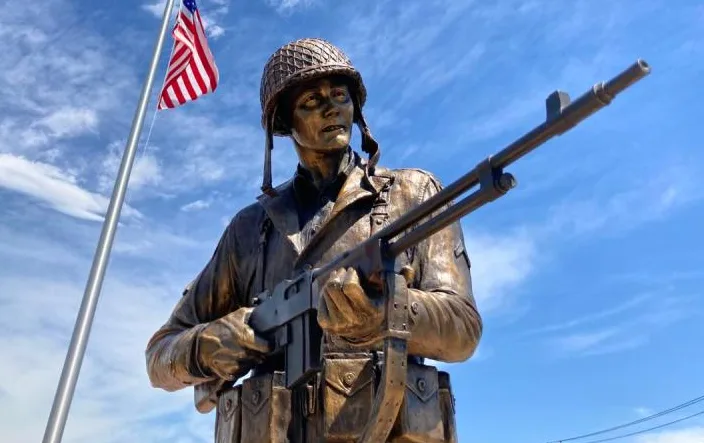
At the center of all of it: a seven-foot bronze statue of Charles DeGlopper, created by sculptor Susan Geissler of Youngstown, New York. The statue was cast in a foundry in Colorado, reviewed and approved by DeGlopper's nephews, and finally unveiled on June 5, 2021, four days shy of the 77th anniversary of his death. A lone bagpiper played Amazing Grace as he marched slowly toward the statue, which was covered with a parachute. DeGlopper's nephews Ray, Charles, Earl, and George, along with Mike Bell, whose grandmother was Charlie's sister, removed the covering together.
Ray DeGlopper, who was a boy on the family farm when his uncle went off to war, told the crowd: "Thank you. Thank you. Thank you."
His Name Is Still Said Aloud
VFW Post 9249 on Grand Island is named after Charles DeGlopper. A road at Fort Bragg, North Carolina is named for him. The Fort Bragg Air Assault School was formally renamed the DeGlopper Air Assault School in 2014. DeGlopper Field is the name of the physical training field between the barracks of the 1st and 2nd Battalions of the 325th Airborne Infantry Regiment, the modern descendant of the unit he served in. A U.S. Army transport ship was renamed the "Pvt. Charles N. DeGlopper" in 1947. In Amfreville, in Normandy, France, there is a monument honoring his sacrifice at La Fiere. An annual ceremony is held there.
On Grand Island, every Memorial Day, his name is read aloud at the park that carries his name. People stop. People listen. A retired major general who spent 33 years in military service stood at the ceremony in 2021 and said: "After serving 33 years in military service, I have seen many of the tributes to him, but it is great to see this one in our hometown."
There is a connection that doesn't get mentioned often enough. The Niland brothers, whose story inspired Saving Private Ryan, also went to Tonawanda High School. Charles DeGlopper graduated from Tonawanda High School in June 1941. The Nilands were from Tonawanda. They walked the same halls. They went off to the same war. Robert Niland was killed on June 6, 1944. Preston Niland was killed on June 7. DeGlopper was killed on June 9. Three days and three men from the same small corner of Western New York, all of them gone in the same week of the same invasion. The 716 gave an extraordinary amount to that war.
Charlie DeGlopper grew up on Fix Road. He went to school on Baseline Road. He is buried on Stony Point Road at Maple Grove Cemetery. His statue stands at Baseline Road and Grand Island Boulevard. He never had to go far. And he never came home. Grand Island has been saying thank you ever since.
Comments
Loading comments...
Leave a Comment