All They Wanted Was a Pool
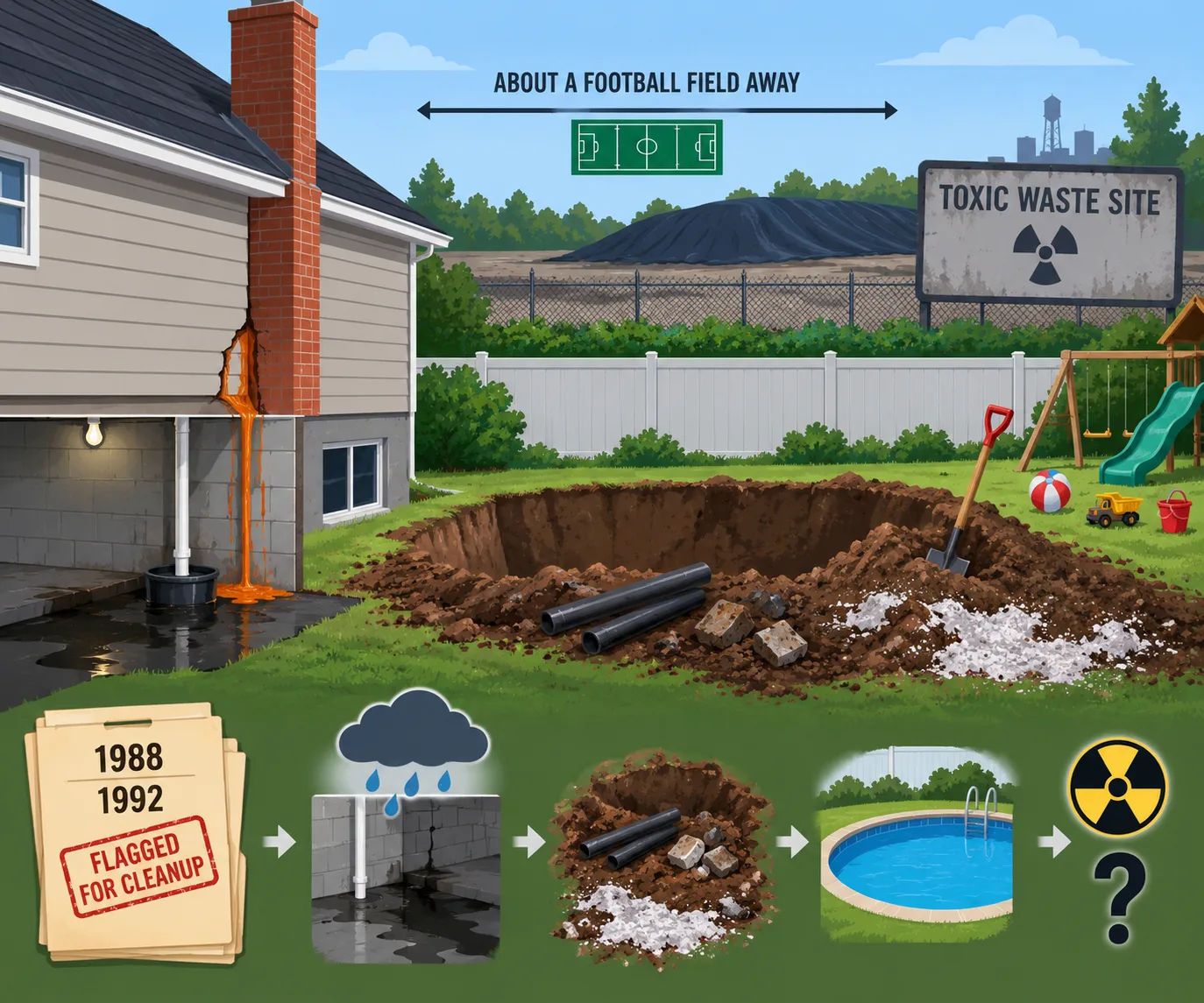
Every parent knows the feeling. It is a hot summer, the kids are restless, and you finally decide this is the year you put in a backyard pool. That is where Daniel and Jocelyn McKiernan started. They have three children, and they wanted to give them a place to splash around at home in Niagara Falls. The excitement did not last long. When they dug into the yard, they found materials buried under the ground, including carbon rods, the kind of thing that has no business being under a family's lawn.
What makes their story land so hard is where they live. Their home on 99th Street sits roughly 300 feet from the Love Canal Superfund site, about the length of a football field from the most notorious toxic waste disaster in American history. Once they saw what came up with the pool dig, a lot of small, strange things they had shrugged off suddenly looked very different. They went public earlier in the summer, sharing their concerns with the Niagara Gazette, and their story quickly became part of a much bigger conversation about what is still buried in Niagara Falls.
The Sludge, the Rods, and the Rain
The signs had been there for a while. Back in 2023, when the McKiernans installed a sump pump and an outdoor drainage system, an orange sludge began leaching through a fracture near their chimney stack. It was a worker from a local basement company, Frank's Basement, who first pointed it out and brought it to their attention. That is a detail worth sitting with. The people who noticed the problem first were not government scientists. They were a local crew doing a routine job.
It did not stop there. The family says a black substance leaches into their basement, especially after heavy rain, and they have seen a white chemical material appear outside the house after rainfall. So they installed the sump pump and drainage in 2023 to fight the water, and instead of solving the problem, the work seemed to open a window onto something buried and old and wrong. For a family with three kids, every rainfall now comes with a question they never should have had to ask.
A Thirty-Year-Old Warning
Here is the part that turned worry into anger. In the summer of 2026, the McKiernans formally asked Governor Kathy Hochul and other top officials to relocate their family and run more comprehensive testing on their property and inside their home. The very next day, they learned something that stopped them cold. Their property, and a nearby stretch described in a DEC document as the Love Canal cap repair area, had been flagged for remediation more than 30 years ago.
Jocelyn McKiernan's response cut straight to the bone. In her view, if the state had this information back in 1988 and in 1992, the right thing would have been to act on it then. Instead, a young family found out the hard way, decades later, while trying to build something happy in their own backyard. As she put it, they should have done the right thing when they had the information, because when you know better, you do better. By late August, the family was pressing the DEC to formally declare a hazardous waste site, arguing that the agency held the power to act and simply had not.
What Love Canal Actually Was
To understand why this family is so shaken, you have to know the ground they are standing on. In the 1940s and 1950s, the Hooker Chemical company buried an estimated 21,000 tons of hazardous chemical waste in an old canal in Niagara Falls, including carcinogens like benzene, dioxin, and PCBs, sealed in metal barrels and covered with clay. In 1953, Hooker sold the land to the Niagara Falls school board for one dollar, with a clause in the contract that both described the buried waste and tried to absolve the company of future claims.
The board built a public school right on the site. Homes went up around it, roughly 200 lining the canal banks and around a thousand more in the surrounding neighborhood. Families moved in with no real idea of what was underneath. Then, in 1978, state officials confirmed that toxic chemicals were leaking up out of the ground and into the basements of those homes. Investigations later found alarming rates of chromosomal damage among residents. It became a national symbol of what happens when industry buries its mess and walks away.
The Woman Who Changed Everything
Out of that nightmare came one of the most important grassroots movements in American history. Lois Gibbs was a young Niagara Falls mother, not a scientist or a politician, when she started knocking on doors and demanding answers about why her neighbors and their children were getting sick. People who investigated back then described going into basements and seeing the oozing, a black substance like tar, with a chemical smell that was impossible to forget.
Gibbs and the women who fought alongside her would not let the government look away. Their pressure forced evacuations, forced accountability, and helped bring about the federal Superfund program, the law that made polluters responsible for cleaning up hazardous sites. What started with ordinary neighbors in a working-class Niagara Falls neighborhood ended up changing environmental law for the entire country.
Why This Keeps Coming Back
After the crisis, the government spent around 230 million dollars capping the canal with clay, a plastic liner, and topsoil, and building a containment and monitoring system. Beginning around 1990, roughly 260 homes just north and west of the landfill were given new siding, roofs, and windows and resold at prices below market value, and the area was renamed Black Creek Village. Officials have long maintained that the containment is working. One EPA spokesman once called the area the most sampled piece of property on the planet.
And yet the worries never fully went away. Years ago, other residents filed lawsuits claiming the same buried chemicals were making them sick again, drawing new families in with promises of cleaned-up land and affordable homes. Now the McKiernans are living a new version of that same fear. The materials they are finding are chemical and industrial in nature, which sets their situation apart from the separate radiation testing the DEC and EPA have been doing elsewhere in Niagara and Erie counties. Different problem, same haunting theme. The past does not stay buried here as neatly as anyone was promised.
A Fight Bigger Than One Backyard
The McKiernans are not the first family to go looking for accountability here, and they will not be the last. Over the years, the canal itself has sat behind a fenced containment area of roughly 70 acres, monitored and maintained by contractors, with officials insisting the system holds. Even so, groups of residents have gone to court in the past, naming the chemical company Occidental, the city of Niagara Falls, and its water board, and arguing that the danger never truly ended. Each new generation of neighbors seems to inherit the same uneasy question about what is really underneath them. For a young family that just wanted a pool, stepping into that long history was never the plan, but here they are, adding their voices to a fight that started before many of them were born.
A Family Still Waiting
As of late August 2026, the McKiernans were still pushing. Still asking for relocation. Still asking the DEC to do what they believe should have been done decades ago. They are doing it for the same reason Lois Gibbs did it almost 50 years earlier, because they have kids, and because a family should be able to trust the ground their children play on.
That is the thread that ties the generations of this neighborhood together. Niagara Falls has produced some of the toughest, most determined advocates this country has ever seen, ordinary people who turned fear into action and made the powerful listen. If history is any guide, this family will not be standing alone for long. The 716 has a way of showing up for its own, and this is a story worth showing up for.
Comments
Loading comments...
Leave a Comment