The Bill That Doesn't Lie
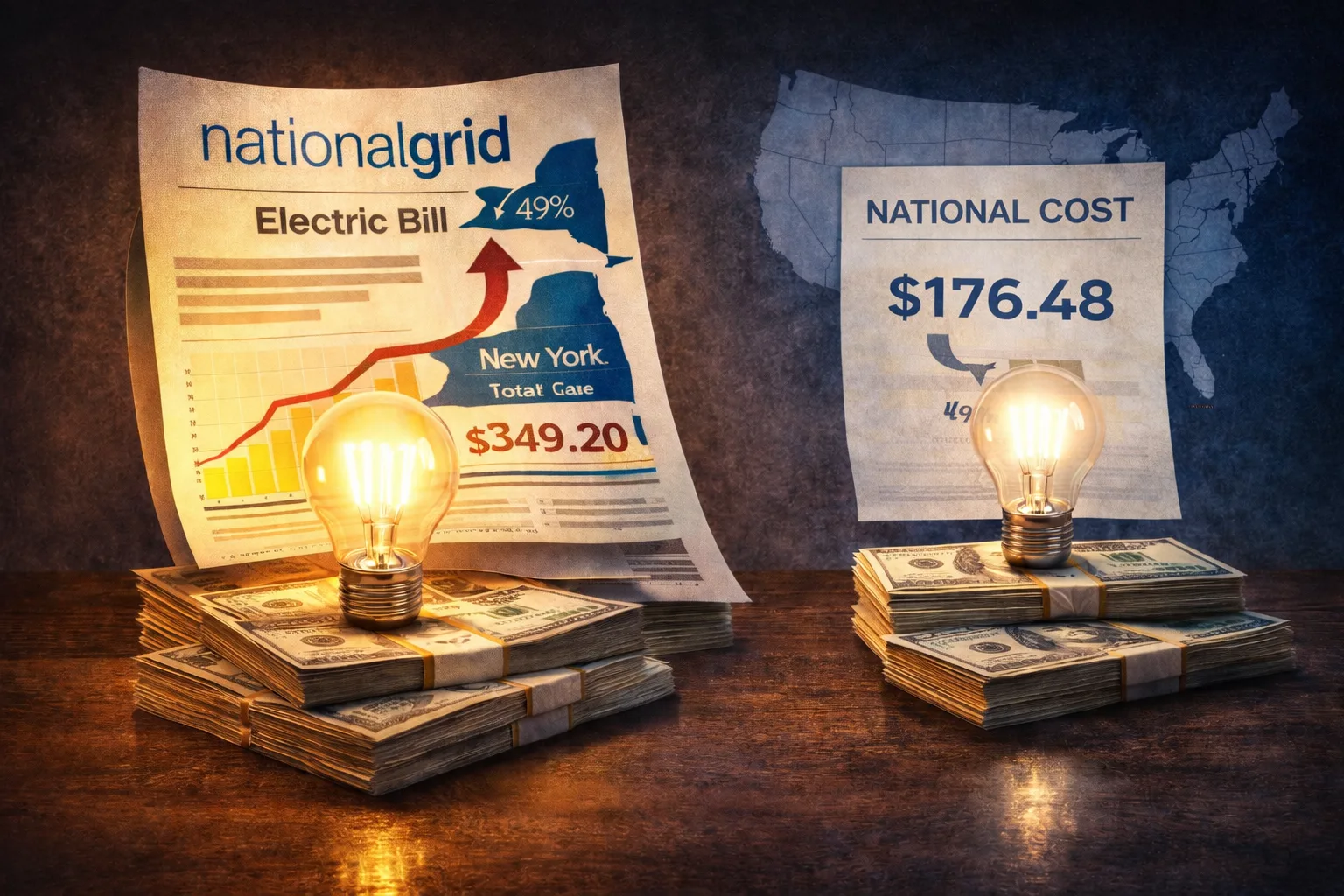
You open the envelope. Or maybe you open the app. Either way, the number on the National Grid bill is bigger than last month, bigger than last year, and bigger than what your friends in other states say they're paying. And you're right to notice. According to federal data from the U.S. Energy Information Administration, New York's average residential electricity rate hit 26.49 cents per kilowatt-hour in November 2025. The national average that same month was roughly 17.78 cents. That puts New York 49 percent above the rest of the country.
It's not a rounding error. It's not a seasonal spike. According to the Empire Center for Public Policy, a nonpartisan Albany-based think tank that tracks energy prices every month, New York has ranked 8th most expensive state in the country for residential electricity. And the gap has been getting wider, not narrower, since 2019.
How We Got Here
For most of the 2000s and 2010s, New York's electricity prices were high but converging with the national average. The gap shrank from about 80 percent above the national average in 2001 down to around 40 percent by 2019. Then something changed. Prices started climbing faster here than in the rest of the country, and the trend hasn't reversed.
In just the past year, New York electricity prices rose 7.1 percent. The national average increase was 5.5 percent. Every year the gap widens, it gets harder to close. The Empire Center's president, Zilvinas Silenas, put it bluntly in a statement: electricity demand and prices are rising nationwide, but New York is seeing costs climb even faster than other states.
Some of that is structural. New York's grid is older and denser than grids in faster-growing Sun Belt states. Aging infrastructure needs constant investment. Transmission costs are high. Property taxes on utility infrastructure are steep. And New York has some of the most aggressive renewable energy mandates in the country, with the state aiming to get 70 percent of its electricity from renewable sources by 2030. That transition costs money, and some of those costs show up on residential bills before the savings do.
Two Parts to Every Bill
Here's something worth understanding about your National Grid bill: it has two distinct sections. The supply charge covers the actual cost of generating electricity. The delivery charge covers everything else: the poles, wires, transformers, substations, meter reading, billing, storm-response crews, and safety inspections.
The supply side fluctuates with market conditions, natural gas prices, and demand. New York's deregulated electricity market means you can shop around for a supply provider and potentially lock in a better rate. There are more than 45 electricity providers operating in the Buffalo area. But no matter who supplies your electricity, National Grid still delivers it, and the delivery charge stays.
National Grid's delivery rates went up as part of a three-year rate plan approved by the New York Public Service Commission in August 2025. The utility cited material and equipment price increases and what it called storm-response readiness needs as justifications for the hike. A National Grid spokesperson told reporters: even if you use zero energy, the utility still must maintain the system that serves your home, so delivery charges remain.
1.28 Million Households Behind
The numbers aren't just abstract. As of December 2025, more than 1.28 million New York households were at least 60 days behind on their energy bills. Statewide utility debt reached $1.84 billion, more than double the pre-pandemic level from December 2019. That's not a figure from a think tank or a political campaign. It comes from energy utility monthly collections reports.
Nearly three dozen state assembly members sent a letter to Governor Hochul in February 2026 calling on her to declare a State of Emergency over electricity costs, describing the situation as historic and unsustainable. State Sen. Tom O'Mara is backing legislation that would return $2 billion to $3 billion in unspent funds from the New York State Energy Research and Development Authority back to ratepayers. That money was collected to promote energy efficiency and renewable energy but hasn't been spent. O'Mara's argument: New Yorkers paid it in, New Yorkers should get it back.
Where Buffalo Fits
There's a wrinkle in the Buffalo story worth understanding. The statewide average of 26.49 cents per kilowatt-hour includes New York City, where rates run significantly higher due to underground infrastructure and Con Edison's cost structure. Estimates for the Buffalo area from third-party energy shopping services have generally pegged local rates lower than the statewide average, in the range of 16 to 24 cents per kilowatt-hour depending on the service, the season, and the provider. The state number is accurate as a state average but shouldn't be read as the specific rate on every Western New York bill.
Still, National Grid territory isn't cheap. New York electricity prices have risen about 25 percent since 2021, according to Palmetto Solar's analysis of EIA data. And because Western New York winters are long and cold, the consumption that drives those bills is higher here than in many other parts of the country.
What You Can Do
Because New York deregulated its electricity market starting in 1999, Buffalo residents have more choices than people in many states. You're not locked into National Grid as your electricity supplier, even though you're locked into them as your delivery utility. You can compare supply rates from competing providers at ny.gov/energyzone or through commercial comparison tools.
Energy Service Companies, called ESCOs, operate in the Buffalo market and offer fixed-rate and variable-rate supply contracts. A fixed-rate plan locks in your per-kilowatt-hour supply cost for a set period, which can offer predictability when market prices are volatile. A variable rate moves with the market, for better or worse.
Community Choice Aggregation programs, where municipalities negotiate rates on behalf of all residents in a service area, are also available in parts of New York and can sometimes secure better rates than individuals shopping alone.
None of this changes the underlying delivery charge, which is National Grid's territory and set by state regulators. But on the supply side, there's room to shop. And in a market where the bills have been going one direction for years, shopping is worth a few minutes of your time.
The Bigger Picture
The electricity affordability problem in New York isn't a Buffalo-specific issue, but it hits Western New York hard because the region is colder, older, and less wealthy than many parts of the state. The combination of high rates, old housing stock that tends to be less energy-efficient, and long heating seasons creates a pressure on household budgets that's real and measurable.
Whether the legislative push for rate relief produces results this year remains to be seen. The state budget process runs through spring, and affordability has become a more urgent political issue with utility debt topping $1.84 billion. For now, what's clear is this: the bill you're holding is not a mistake, and you're not alone in feeling the squeeze.
Comments
Loading comments...
Leave a Comment