A Tonawanda Family and the Story That Became a Movie
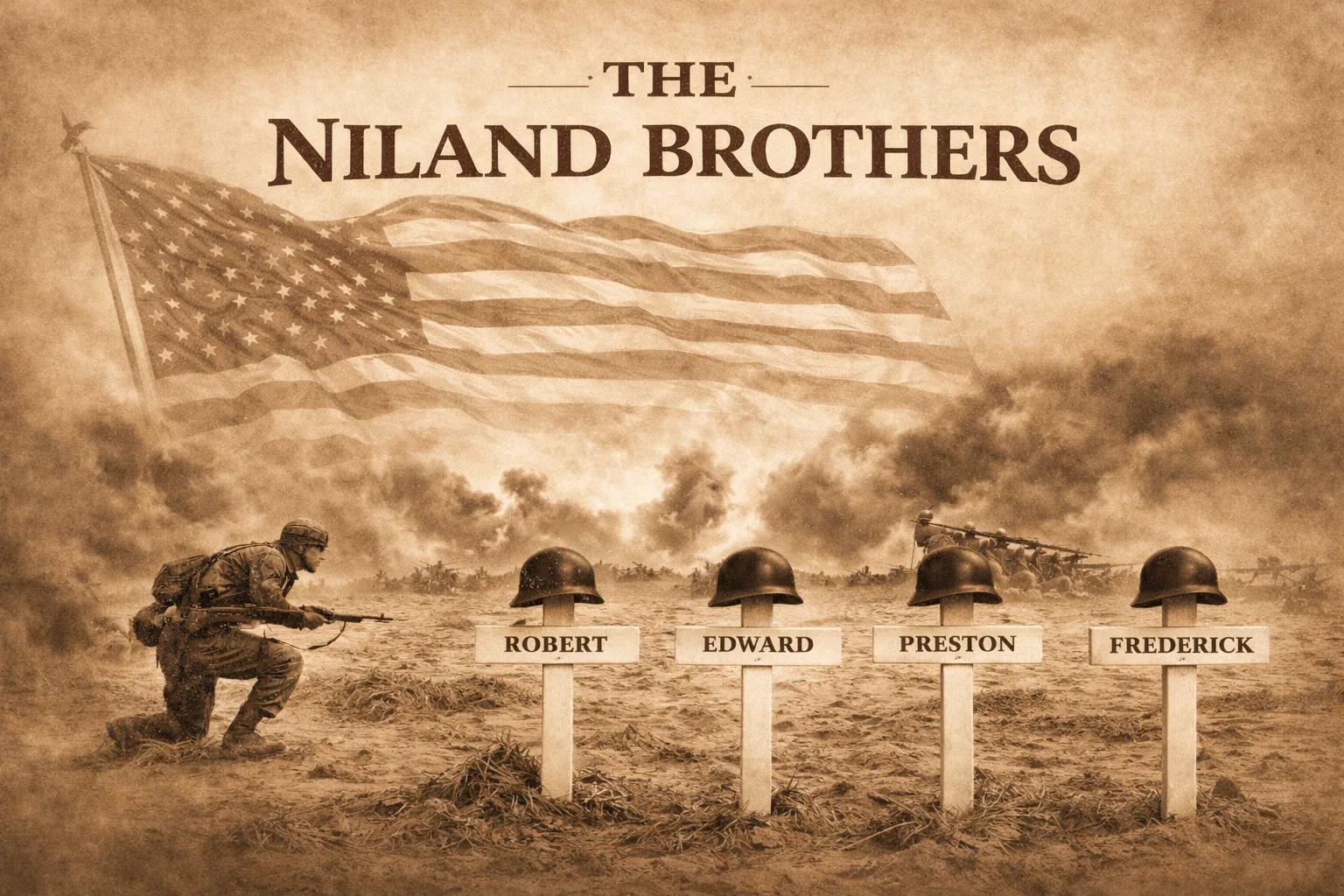
If you have ever watched Saving Private Ryan and wondered whether the story was real, it was. And it did not happen in some faraway place. The Niland brothers grew up right here in Tonawanda, a blue-collar city on the Niagara River just north of Buffalo. Edward, Preston, Robert, and Frederick "Fritz" Niland were the sons of Michael and Augusta "Gussie" Niland, an Irish-American family with deep roots in the community. Their grandfather, Mike "The Bull" Niland, served under Teddy Roosevelt. When World War II came, all four brothers enlisted. It was that kind of family.
The Nilands were not the only ones from the household who served. Their cousin Thomas Niland Jr. jumped on D-Day as a first lieutenant with the 101st Airborne. Another cousin, Joseph Niland, served in the Army's 20th Armored Division and helped liberate over 32,000 prisoners at Dachau. Their sister Clarissa was a nurse at DeGraff Memorial Hospital in North Tonawanda. The whole family gave everything they had.
Scattered Across the War
By the spring of 1944, the four Niland brothers were spread across two hemispheres. Edward, the oldest, was a Technical Sergeant flying missions as a radio operator and tail gunner on B-25 Mitchell bombers in the China-Burma-India Theater. Preston was a Second Lieutenant with the 22nd Infantry Regiment, 4th Infantry Division. Robert was a Technical Sergeant with D Company, 505th Parachute Infantry Regiment, 82nd Airborne Division. And Fritz was a Sergeant with the 501st Parachute Infantry Regiment, 101st Airborne Division.
In May 1944, before the invasion had even begun, Michael and Gussie Niland received word that Edward had been shot down over Burma and was missing in action, presumed dead. Three sons were still fighting. Then June 6 came.
Three Telegrams
On D-Day, Robert parachuted into Normandy near Sainte-Mere-Eglise and was sent to establish a perimeter defense at the village of Neuville-au-Plain. While two German companies launched a counterattack, Robert manned a machine gun with two other men to buy time for a retreat back to Ste. Mere-Eglise. The two men escaped. Robert was mortally wounded and died on June 6, 1944. He was 24 years old.
Preston made it off Utah Beach the next morning. Moving through Normandy on June 7, he stepped out of formation to help a wounded soldier and was killed by German artillery fire. He was 29 years old.
Back in Tonawanda, Gussie received the Western Union telegrams one after another. First Edward, missing over Burma. Then Robert, killed on D-Day. Then Preston, killed the day after. Three sons in days. Those faded Western Union telegrams still hang in a family member's den today, alongside a letter from President Franklin D. Roosevelt.
Finding Fritz
The War Department, upon learning that three Niland sons had been lost, invoked what would become the Sole Survivor Policy and ordered Fritz to be located and sent home. Army chaplain Father Francis Sampson, with the 501st, was given the task. He found Fritz with relative ease. Fritz had already made his way to the 82nd Airborne hoping to find his brother Robert when he was told the news. He then went to an Army morgue and read his brothers' names himself.
Fritz was sent back to the United States, where he finished his service as a military policeman in New York and was awarded the Bronze Star. It was his journey home, and the Army's effort to find him, that inspired the storyline of Steven Spielberg's 1998 film. Fritz Niland died in 1983 and is buried at Fort Richardson National Cemetery in Tonawanda. His brothers Robert and Preston are buried side by side at the Normandy American Cemetery at Colleville-sur-Mer, France.
The Part the Movie Left Out
Saving Private Ryan ends with the family intact, the soldier home, the mission complete. What the movie does not tell you is what happened to Edward.
Edward had not been killed when his B-25 went down over Burma. He had parachuted out, spent days wandering through the Burmese jungle, and was captured by Japanese forces on May 16, 1944. He was held in a prison camp in Burma for nearly a year. When British soldiers liberated the camp in May 1945, Edward Niland weighed just 80 pounds.
The whole time he was gone, Gussie set a place for him at the dinner table every single night. She never stopped. Edward came home to Tonawanda. He lived there the rest of his life and died in 1984 at the age of 71.
Tom Hanks, Spielberg, and a Letter to Tonawanda
The Niland family was invited to the premiere of Saving Private Ryan in 1998. They have scrapbooks full of photographs with Steven Spielberg and Tom Hanks from that night. It was a Hollywood premiere, but what it really was for the family was a recognition that the story the whole world was watching belonged to people from their city, from a modest neighborhood on the Niagara River.
Years later, when a monument honoring the Niland brothers and Tonawanda's Sgt. Warren "Skip" Muck, a central figure in Band of Brothers, was dedicated in Niawanda Park along the river, Tom Hanks sent a written message for the occasion. It read: "The long ago friendship of Skip Muck and Fritz Niland is a coincidence for the ages, one that connects two families and the City of Tonawanda with history and bravery, sacrifice and loss. The attention paid to Skip and Fritz by this monument to their lives, and the qualities of Duty, will forever define what it means to be an American living in troubled times. God Bless you all."
The monument was funded by an Amherst couple, Rick and Lisa Lewis, who donated $150,000 for the multi-stone memorial. It was dedicated in Niawanda Park, directly behind Tonawanda City Hall, illuminated at night along the edge of the Niagara River. The stone reads: "A grateful community solemnly promises that the sacrifices of all veterans were not made in vain and that they will never be forgotten."
The Legacy Keeps Going
The Niland family's service did not end with World War II. In 2024, on the 80th anniversary of D-Day, a young family member named Lt. Junior Grade James Niland was training to fly Romeo helicopters in Rota, Spain, after being inspired to join the Navy by watching the Blue Angels over Buffalo. "Having a part in the legacy of my great uncles fighting in Europe, fighting to protect my brothers and sisters over there, it all lined up," he said.
On the 80th anniversary of D-Day in June 2024, members of the Niland family traveled to Normandy, France, where Preston and Robert are buried side by side. They stood at the graves. They said the names. They came home to Tonawanda.
There is one more connection worth knowing. Charles DeGlopper, the Grand Island soldier who earned the Medal of Honor for his actions on June 9, 1944, just three days after D-Day, went to Tonawanda High School with the Niland brothers. He and Robert, Preston, Fritz, and Edward walked the same halls. They grew up in the same corner of Western New York, went off to the same war, and made their stands within days of each other. DeGlopper is honored with his own statue and park on Grand Island. The Nilands are honored in Niawanda Park on the river. The 716 produced more than its share of heroes that summer.
The monument in Niawanda Park is still there, lit up at night along the Niagara River. If you drive through the city and stop, you can read the stones. Four brothers from a modest neighborhood. A mother who set a place at the table every night for a son she refused to believe was gone. A letter from Tom Hanks. Scrapbooks with Spielberg. And a story that turned out to be more remarkable than the movie it inspired.
Comments
Loading comments...
Leave a Comment