The green patch nobody thought twice about
If you've spent any time in Buffalo's Old First Ward, you know the little green plot along Ohio Street, over by Chicago Street and the water. It's the kind of spot that doesn't announce itself. A patch of grass a few steps from Buffalo RiverFest Park, tucked in among the old brick and the newer breweries. Plenty of neighbors walked past it for years and quietly assumed it would stay that way.
Jade Marciniak was one of them. She'd always pictured it as a little park, a nice bit of green in a corner of the city that has spent the last decade slowly waking back up. She liked that it was a touch out of the way, quiet, with a little nature to it. So when the land started to change, the surprise landed hard.
That green patch is about to become a gas station.
What's actually being built
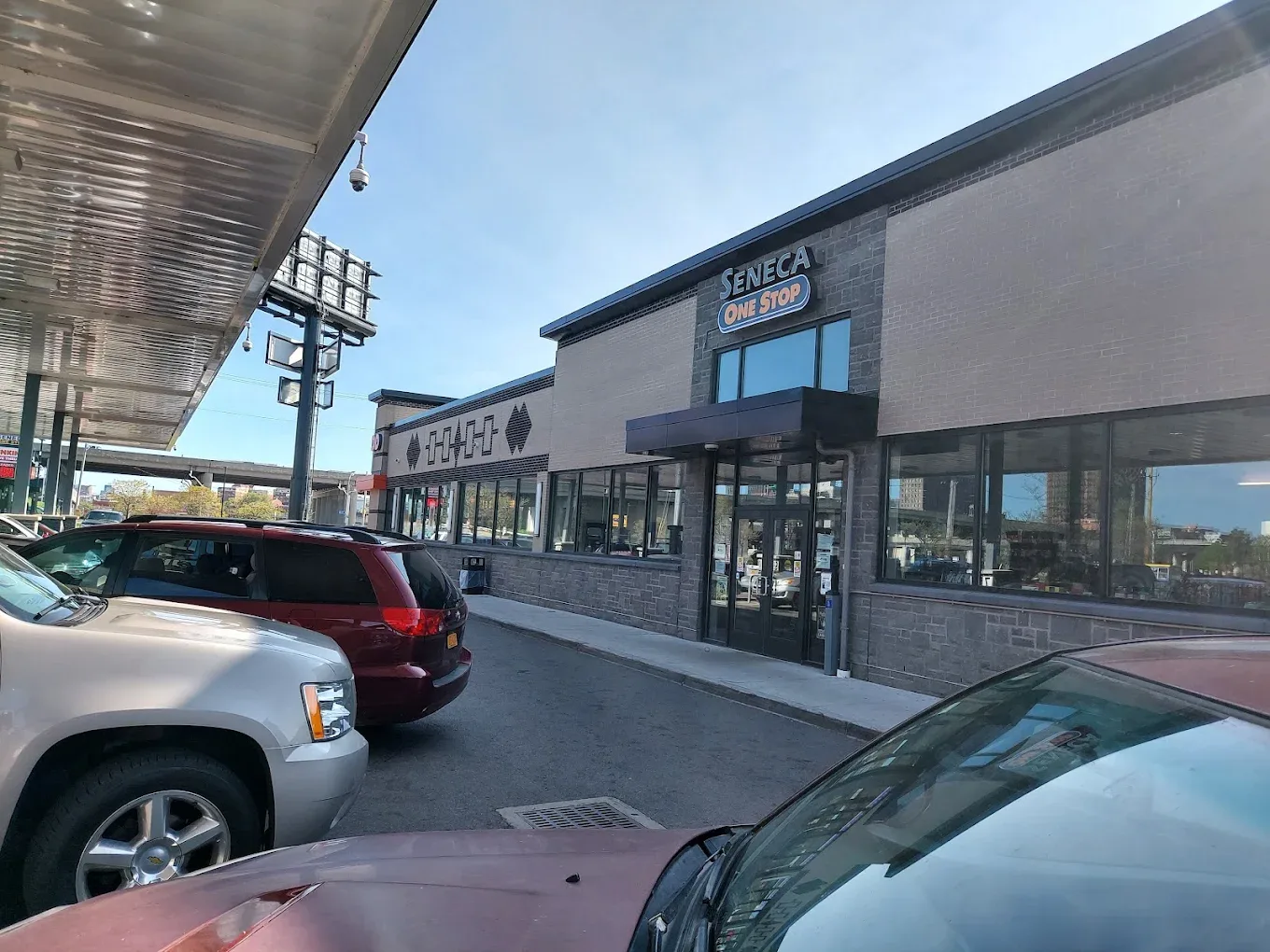
In early September, the Seneca Nation of Indians confirmed plans to build a second Seneca One Stop along Ohio Street, on Nation-owned land at 5 Miami Street. The project includes a fuel station, a convenience store, and a cannabis shop. Work has already started on the 3.4-acre parcel, which the Nation purchased in 2022 for $326,000.
The location puts it across from Buffalo RiverFest Park, near Resurgence Brewing Company and Hartman's Distilling, and across the way from the Tewksbury Lodge. It sits less than a five-minute drive from the Nation's first downtown One Stop, at the corner of Michigan Avenue and Perry Street, which opened in 2021 with 14 gas pumps, a convenience store, and a Dunkin' drive-thru.
The Nation says the second station is meant to boost economic activity in the area and to ease the congestion at that first One Stop, which anyone who's tried to pull in on a busy afternoon can tell you gets tight. The business logic is straightforward. Because the stores sit on sovereign land, the fuel and tobacco they sell aren't subject to the same state taxes as the stations up the block, which keeps prices lower and the pumps busy. A second location spreads that traffic out.
Why the city can't step in
Here's the part that surprises a lot of people. The parcel is sovereign Seneca Nation territory. It's recognized as Nation land under the Seneca Nation Settlement Act of 1990, which means the City of Buffalo has no municipal control over what gets built there. No zoning fight, no site plan review at City Hall, no public hearing that a neighbor could show up to and speak against.
That's a big reason some residents felt caught off guard. Paul Marzello, who lives nearby, said folks in the area found out what was happening simply by watching it happen. He described seeing dump trucks and bulldozers start plowing the land across the street, and neighbors trading concerned looks, because no one had told them anything. When there's no meeting on the calendar and no sign staked in the grass, the first notice a neighborhood gets is the sound of the machines.
Buffalo Common Council member Mitch Nowakowski, who represents the district, has shared concerns of his own about how the station fits into the neighborhood. In a statement, he said he recognizes and respects the sovereignty of the Seneca Nation, while noting plainly that he has no municipal control over the project. That tension, respect for sovereignty on one hand and a lack of any local lever on the other, is the whole story in a sentence.
The Nation's case
Seneca Nation President J. Conrad Seneca framed the project as another investment in a corridor that's been on the upswing. He pointed to the success of the Seneca Buffalo Creek Casino and the existing One Stop as pillars of the economic growth taking place along Ohio Street and the surrounding area, and said the Nation is proud to keep that momentum going.
He also drew a line back through history. This stretch of the Buffalo River sits on the Nation's aboriginal lands, ground where, as President Seneca put it, ancestors conducted trade and commerce among themselves and other nations for generations. For the Seneca Nation, building here isn't an intrusion into someone else's neighborhood. It's commerce returning to a place it has long belonged. That's a perspective that doesn't always make it into the conversation when a project like this gets debated, and it's worth sitting with.
The neighbors' case
The people who live and work along Ohio Street aren't arguing with any of that. Their worry is simpler and closer to home. They've watched this street transform, and they're nervous about what a fueling station does to the feel of it.
Marciniak summed up the mood when she said a gas station just isn't the neighborhood vibe, and that losing the quiet green corner was a bummer. Mike Santillo, who owns Mammoth Cannabis at 212 Ohio Street, put a finer point on it. He wondered aloud who's going to want to pay to live in the apartments across the street, or hold a wedding reception at Tewksbury Lodge, with fuel pumps next door.
These aren't abstract complaints. They come from people with a stake in the block, business owners and renters and walkers who bet on Ohio Street becoming something and are watching a very different kind of anchor go in. Santillo's point about the lodge cuts especially close. A wedding venue and a gas station are two very different ideas about what a riverside street is for, and once the pumps are in, you don't get to run that experiment over.
How Ohio Street got here
To understand why this stings for some, you have to know what Ohio Street used to be. Not that long ago it was an industrial connector, a road you drove through to get somewhere else. Over the last several years it's made real strides toward becoming a mixed-use corridor, with a focus on a pedestrian-friendly streetscape, new housing, breweries, river access, and parks.
Resurgence Brewing's patio, the RiverFest Park green space, the growing cluster of small businesses, all of it points in one direction, toward a walkable riverside neighborhood. People moved into the new apartments and opened the new shops on the strength of that vision. A second gas station, to the residents worried about it, feels like a step in the other direction, back toward the industrial past the street has spent years trying to grow out of.
What the neighbors are actually asking for
Listen closely to the residents and you notice something. Very few of them are demanding the project be stopped, which they know it can't be. What most of them wanted was simpler. A heads-up. A conversation. The chance to know what was coming to their block before the equipment arrived, rather than after.
That's the quiet ache underneath this whole story. Not just a gas station, but the feeling of a decision landing on your street with no door to knock on. It's a hard spot, because the very sovereignty that lets the Nation build without city approval is real and hard-won, and deserves respect. Threading that needle, honoring sovereignty while still building trust with the people next door, is the work ahead for everyone involved.
Two things that are both true
The honest thing to say about this one is that there's no villain in it. The Seneca Nation is a sovereign government making a legal investment on its own land, on ground with deep historical ties, and it's under no obligation to run its plans past the neighbors first. The neighbors, meanwhile, aren't wrong to feel blindsided or to worry about the character of a street they've watched bloom.
Both of those things can be true at the same time. What happens next, how the station is built, how it sits alongside the breweries and the apartments and the little that's left of that green corner, will tell the next chapter. For now, the bulldozers are the loudest voice on Ohio Street, and the people who live there are watching, and waiting, to see what their neighborhood becomes.
Comments
Loading comments...
Leave a Comment