
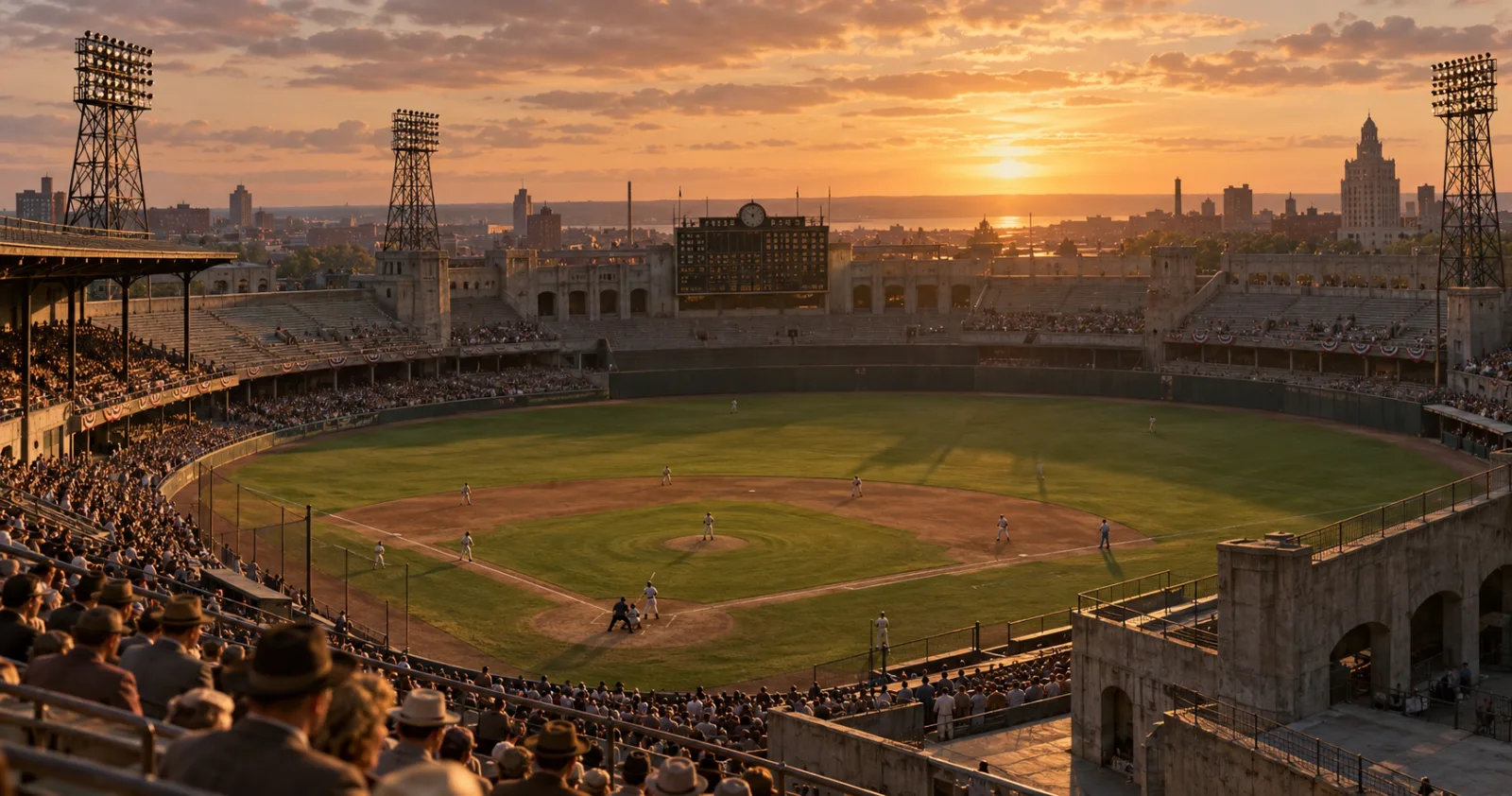
A Saturday on Dodge Street
On Saturday, October 16, 1937, Buffalo opened a big new stadium of its own on the East Side. It sat on the block at Dodge Street, Best Street and Jefferson Avenue, and it cost $3 million to build as a Works Progress Administration project. Ground had been broken back in 1935.
The land already had a story. It had once held the Prospect Reservoir, and a wall of big, heavy stones from the old reservoir still ran along the edge of Masten Park right next door.
For the first game, 32,524 people packed in to watch Tulane play Colgate. It was a tight one. Tulane won it 7-6.
Not everybody was there just for fun. A University of North Carolina coach named Bill Lange made the trip to scout Tulane, who were next on his team's schedule. The student paper in Chapel Hill reported that he came back from Buffalo saying it was Tulane's passing game that won it.
Somewhere in the stands that day, a man with a camera took three pictures, including one he managed to sneak of the press box. Decades later, one of his kids posted them online and said the best part was the hats, a microphone sitting on top of a trunk, and the headphones. It's a small thing, but it's exactly what you'd notice if you'd been there.
A Stadium That Couldn't Keep a Name
It opened as Roesch Memorial Stadium, named for Charles E. Roesch, Buffalo's mayor from 1930 to 1934. That name didn't last. Before long it was Grover Cleveland Stadium, after the former president who'd also been mayor of Buffalo. By 1938 the city settled on Civic Stadium. As one history of the place points out, the first name honored a Republican, the second a Democrat, and the third nobody at all. It finally became War Memorial Stadium in 1960.
Pro football came back to Buffalo there on September 16, 1938, when the Philadelphia Eagles beat the Pittsburgh Pirates in front of 19,746 fans. The Buffalo Indians, later the Tigers, moved in for 1940 and 1941. The first Buffalo Bills, the All-America Football Conference version, played there from 1946 through 1949. Canisius called it home, and so did the UB Bulls from 1946 to 1954.
In 1940 a quarter-mile cinder track went in around the inside of the stadium, and race nights took over. Midget cars and stock cars tore around that little oval, and NASCAR showed up in 1956 and again in 1958. The track was so tight that drivers had to leave the stadium for pit stops at the nearby Masten Armory, and nobody was allowed to sit in the first five rows.
The Night Two High Schools Filled the Place
Here's the part a lot of people don't know. The biggest crowd the old stadium ever held didn't come for the Bills or the Bisons. It came for two Buffalo high schools.
On Thursday night, October 21, 1948, Bennett and Kensington met in the first Harvard Cup game ever played under the lights. According to the Courier-Express the next morning, 50,988 people jammed into a stadium that normally seated 37,064. Kids and grown-ups squeezed into every inch they could find. Stadium director James Carney said that number was the actual turnstile count.
Before kickoff, the crowd stood bareheaded while Miss Gertrude Lutzi sang the national anthem, backed by both school bands: Bennett's in orange and blue, Kensington's in green, gold and white. Then Kensington went out and beat previously unbeaten Bennett, 26-8. It was the defending Harvard Cup champs' third win of the season and stretched their unbeaten run to ten games over two years.
That 50,988 still stands as the stadium's record attendance. A high school game. That's Buffalo for you.
The Bills, the Bisons and the Hit Heard 'Round the World
In 1960 the race track came out so the place could handle both baseball and football. The new AFL Bills moved in, and the Bisons followed in 1961 when their old home, Offermann Stadium, was set to come down. It was never a tidy fit. The baseball diamond pointed to the southeast, and the football field ran along the third base line. In 1965 the stadium was expanded to hold more than 46,000.
The best day the Rockpile ever had came on Saturday, December 26, 1964. The 12-2 Bills hosted the defending champion San Diego Chargers for the AFL title in front of a sellout crowd of 40,242. San Diego scored on its opening drive, and things looked shaky.
Then Mike Stratton timed it perfectly. As a pass arrived for Chargers running back Keith Lincoln, Stratton drove his right shoulder into Lincoln's ribs and put him down on the frozen turf. Lincoln left the game with cracked ribs, and the Chargers never scored again. Pete Gogolak kicked two field goals, Wray Carlton ran one in, and Jack Kemp added a touchdown in the fourth quarter. The Bills won 20-7 for their first league championship.
Bills team photographer Robert L. Smith caught the hit on film. The team calls it the most famous photo in Buffalo Bills history, and the play has been known ever since as the Hit Heard 'Round the World.
The old place never did get pretty, though. Sports Illustrated writer Brock Yates joked in 1969 that it looked as if the war it honored had been "fought within its confines." Nobody's completely sure where the nickname came from. Some say it was how run-down the stadium got. Others point to those big stone walls. Either way, Buffalo called it the Rockpile, and the name stuck harder than any of the official ones.
Big Names on Jefferson Avenue
The Rockpile saw more than its share of famous faces. From 1961 through 1965 it hosted the Coaches All-America Game, an exhibition for the best college seniors heading to the pros. In the summer of 1951, the Hamilton Tiger-Cats beat the Toronto Argonauts 17-11 there in a CFL preseason game.
On August 19, 1963, the New York Yankees came to town for an exhibition against the International League All-Stars, and Mickey Mantle, Yogi Berra and Whitey Ford all played. The minor leaguers won it, 5-0. Decades later, on April 5, 1987, the Cleveland Indians and Toronto Blue Jays played an exhibition there that ended in an 8-8 tie.
Not every big day went Buffalo's way. On New Year's Day 1967, the Bills hosted the AFL Championship again and lost to the Kansas City Chiefs, 31-7, in front of 42,080 fans.
Leaving, and Then Hollywood
After the AFL and NFL merged, the league wanted stadiums with at least 50,000 seats, and the Rockpile couldn't be expanded enough. Rich Stadium went up in Orchard Park, and the Bills played their last season on Jefferson Avenue in 1972. The Bisons had already left in the middle of the 1970 season, when the franchise moved to Winnipeg.
The stadium sat empty until 1976, when the Buffalo Blazers soccer team arrived. A brand-new Bisons franchise brought baseball back in 1979, and Canisius signed a ten-year deal to use the place that same year.
Then Hollywood showed up. In 1983, Robert Redford and the crew of The Natural filmed at the Rockpile, which played the home ballpark of the fictional New York Knights. Its old-time look gave the movie an almost eerie backdrop, and it made the stadium famous to people who'd never set foot in Buffalo.
The Bisons moved downtown to Pilot Field on Washington Street after the 1987 season, about two miles away. The last event at the old stadium came in May 1989, when Akron beat Canisius in baseball, 11-2.
What's Still Standing
The stadium came down after that. In its place, the city built a high school athletic complex in 1992 for $6.8 million, and it's known as the Johnnie B. Wiley Amateur Athletic Sports Pavilion.
The city held on to some pieces of the past, though. The old main gate still stands at Best Street and Jefferson Avenue, which sat just beyond center field back in the baseball days. Another original entrance stands at Dodge Street and Jefferson Avenue, behind what used to be the left field corner. Home plate sat roughly where the 15-yard line is now at the north end of the turf football field.
The flagpole from center field made the trip downtown, too. It was installed at Pilot Field, now Sahlen Field, in July 1990. Buffalo baseball historian John Boutet spent years collecting other pieces of the old place for the Buffalo Baseball Museum at the downtown ballpark, including an original turnstile and a gray wooden stadium seat.
Eighty-Nine Years Later
Friday, October 16, 2026, marked 89 years since that first game on Dodge Street. The stadium has been gone for more than three decades, but its gates still stand on Jefferson Avenue, and kids still play ball on the same ground.
Everybody who went has a Rockpile memory. That same photographer's kid remembered heading to the stock car races at Civic Stadium in the 1950s, tagging along with a big brother and a friend everybody called "The Walrus." Your grandfather probably has one, too. Maybe it's the hit, maybe it's The Natural, maybe it's a cold night watching the Bisons. Ask him. It's worth hearing.
Comments
Loading comments...
Leave a Comment