
A Parade for a Building
Buffalo doesn't throw a parade for just anything. But on Monday, October 14, 1940, the city threw one for a building.
Wednesday, October 14, 2026 marks 86 years since Buffalo Memorial Auditorium opened at the foot of Main Street. There was a parade. There was a luncheon for 3,000 people, with the mayors of more than 60 local communities in the room. The Sabres' own history of the building calls it one of the largest civic celebrations Buffalo had ever seen.
The new hall cost $2.7 million. It measured 422 feet by 262 feet, and its 12,280 hockey seats climbed up in tiers of red, blue and gray. It was formally dedicated to the memory of those who died in combat in World War I, and that's where the "Memorial" came from. Give it a few years, though, and nobody called it any of that. It was just the Aud.
For 56 years, if something big happened under a roof in Western New York, odds are it happened there. Hockey, basketball, lacrosse, soccer, circuses, dog shows, rock concerts. Generations of families walked those ramps. If you grew up here, you probably still remember the smell.
Built Where the Canal Used to Run
The Aud was a New Deal project, built with help from federal public works money. It replaced the aging Broadway Auditorium, an old armory drill hall that the city had been using as a public auditorium since 1913.
Workers laid the cornerstone on November 30, 1939, at one end of what had once been the Erie Canal, right where the old canal met the Main-Hamburg Canal. That was the heart of the old canal district on the waterfront. Over the next couple of decades, the Aud, the Skyway and the Thruway would cover most of that district for good, and the old canal slips were buried and forgotten.
People noticed what was happening down there. On December 31, 1939, Buffalo Evening News reporter Nat Gorham wrote that "the Terrace once more is coming back to life," and he described crowds of ordinary folks stopping by every day just to watch the new hall go up.
Hang on to that cornerstone, because it comes back later in this story. Sealed inside was a copper time capsule, and nobody would see what was in it for 70 years.
The Night Montreal Came to Town
For its first 30 years, the Aud belonged to the Buffalo Bisons of the American Hockey League. They played 30 seasons there starting in 1940 and won five Calder Cups. The last one came in 1970, in the final game the franchise ever played. Then the Bisons folded to make room for something bigger.
The Buffalo Sabres played their first NHL game on Saturday, October 10, 1970, in Pittsburgh and won it 2-1 on a goal by a rookie named Gilbert Perreault. Five nights later, on Thursday, October 15, 1970, they came home to the Aud for the first time.
The opponent was the Montreal Canadiens. Before the real opening faceoff, Sabres owner Seymour H. Knox III dropped a ceremonial puck between Buffalo's captain, Floyd Smith, and Montreal's captain, the great Jean Beliveau.
Smith was 35 and had been coaxed out of retirement to be the Sabres' first captain. In 2019, during the team's 50th season, he told the Associated Press he still had a vivid memory of that ceremonial faceoff. "(Beliveau) let me win it," he said with a laugh.
That was about the only thing Montreal let Buffalo win that night. The Canadiens shut out the Sabres 3-0. Perreault, a Quebec kid who'd played his junior hockey in Montreal, later said he went into that game thinking he'd be skating against his idol, Beliveau. Welcome to the NHL, kid.
Knox would later call the Aud an old friend. It didn't take long for the whole city to feel the same way.
They Actually Raised the Roof
Here's a Buffalo story that sounds made up but isn't. After that first season, the Sabres needed more seats. So they lifted the roof.
The $8.7 million renovation in 1971 raised the Aud's 2,200-ton roof 24 feet and built a whole new upper level underneath it. That job cost close to three times what the entire building had cost in 1940. When it was finished, the Aud could hold around 18,000 people.
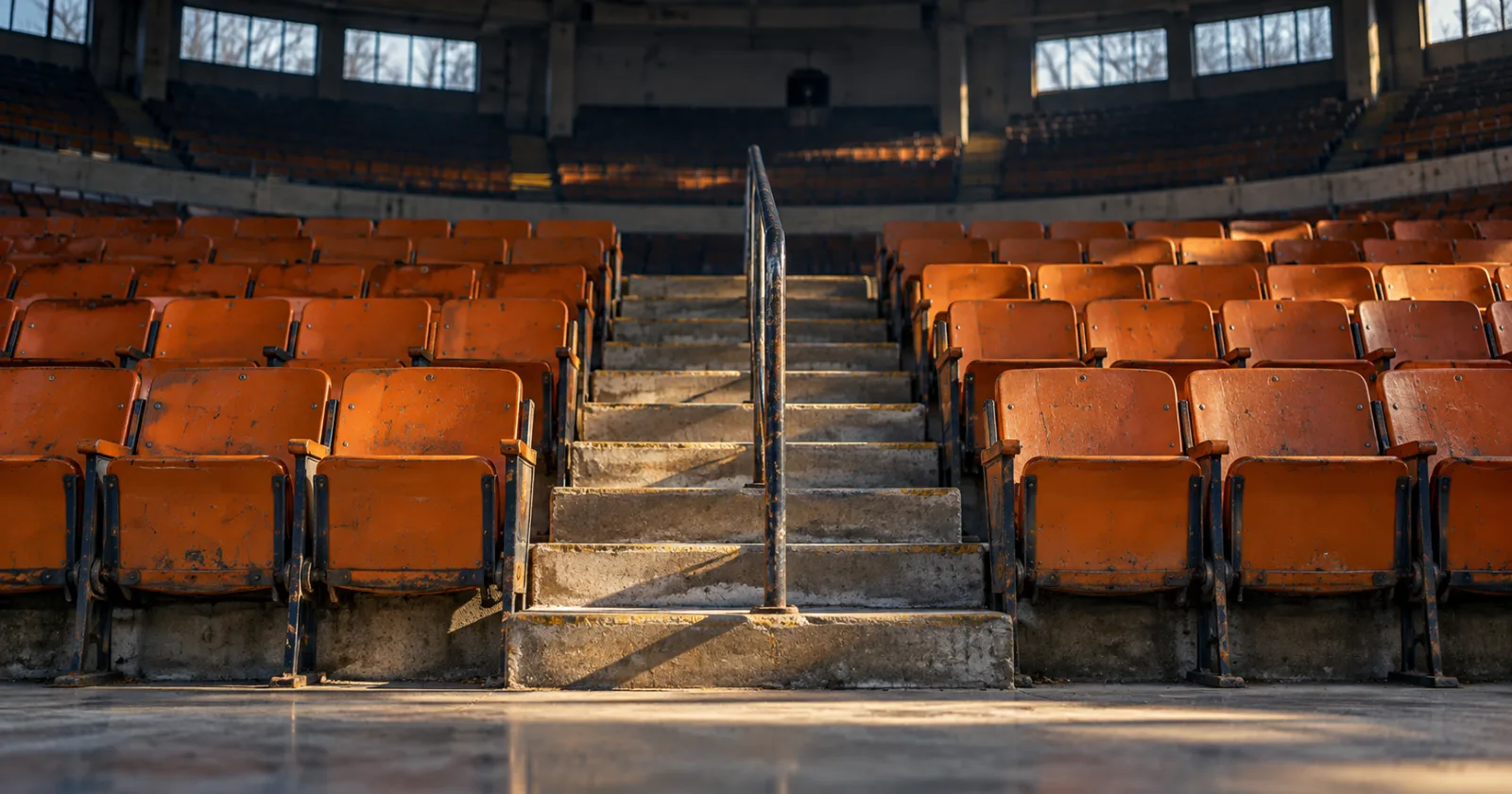
The new seats were orange, and the oranges became legend. They hung way up high over steep stairs, and tickets could go for as little as seven dollars. People who sat up there swear it was the best view in hockey. They'll also admit that jumping up for a goal took a little nerve when the next row down felt a mile below you.
Down below, the seat colors told you where you were: golds right up against the glass, then reds, then blues. The ice itself was smaller than what the NHL plays on now, 196 feet long instead of 200, and the Aud was the last NHL rink that came up short of the league's standard size. Players were closer. Hits were louder. The glass rattled. The whole building felt like it was leaning in.
What It Felt Like Inside
Ask anybody who went to games there, and they'll start with the walk in. You handed over your ticket at the turnstile, somebody hollered about programs, and then you wound your way up dark, twisting ramps where popcorn and smoke hung in the air together. Somewhere, a vendor was yelling about cold beer.
When the place was full, it shook. Thousands of acoustic cylinders hung from the ceiling, and on the big nights you could see them sway. It was no fun at all if you played for the visitors, and when the Maple Leafs or the Canadiens came to town, everything felt bigger. After the game, the ramps echoed with the sound of empty beer cups going pop.
Then there were the voices you'd know anywhere. Milt Ellis was the Sabres' public address announcer for 27 years, working from a desk between the two penalty boxes, and he'd called Bisons games before that. Long before cell phones, Milt would page doctors in the crowd and ask them to call their answering service. Norm Wullen played the organ from 1970 until he retired in 1985, bouncing from the "Sabre Dance" to "Hava Nagila" to the Addams Family theme. Tenor Joe Byron sang the anthems, and he always sang "O Canada" first. That was the Knox brothers' call, a nod to the fans who came over from Canada and to a roster that was mostly Canadian.
Kids crowded down by the dressing rooms, where only a folding fence stood between them and the players heading out to the ice. If you were lucky, you went home with a beat-up stick or a practice puck. That's the kind of thing a kid never forgets.
The Nights Nobody Forgets
Funny enough, one of the Aud's most famous moments came in a loss, and it came against Montreal. In 1973, just their third season, the Sabres made the playoffs for the first time and drew the Canadiens, who went on to win the Stanley Cup. Buffalo lost the series in six games. But as Game 6 wound down at the Aud, the crowd started a chant that grew into a roar: "Thank you, Sabres." Two years later, fans did it again at the end of Game 6 of the Stanley Cup Final.
That 1975 Final also gave us the Fog Game. On Tuesday, May 20, 1975, in Game 3 against the Philadelphia Flyers, it was 82 degrees and the Aud had no air conditioning. Fog settled over the ice so thick that a lot of people in the stands couldn't see the players or the puck. A bat swooped down over the rink, and Sabres forward Jim Lorentz knocked it out of the air with his stick. Rene Robert won it in overtime, 5-4.
The list keeps going. In 1976, the Sabres beat the Soviet Army team 12-6 on Aud ice. On February 24, 1982, Wayne Gretzky scored a natural hat trick against Buffalo to break Phil Esposito's single-season goal record, and Perreault answered with a hat trick of his own in a 6-3 loss. In 1986, Perreault scored his 500th career goal there, and his teammates hoisted him onto their shoulders. In 1993, Brad May's "May Day" overtime goal finished off a sweep of the Boston Bruins. And in 1994, Dave Hannan scored in the fourth overtime of Game 6 against the New Jersey Devils while Dominik Hasek stopped 70 shots. That one ended at 1:52 in the morning.
And it was never only hockey. The NBA's Buffalo Braves called the Aud home from 1970 to 1978. Canisius played college basketball there from 1940 to 1995. The Bandits brought indoor lacrosse there in 1992. In between came circuses, dog shows and concerts by just about everybody, Led Zeppelin included.
Lights Out
By the 1990s, the old barn was showing its age. Air conditioning and elevators didn't arrive until 1990, and by then the talk had already turned to a new arena a few blocks away.
The Sabres played their last game at the Aud on Sunday, April 14, 1996, and beat the Hartford Whalers 4-1. Michael Peca scored the last real goal in the building. Then Pat LaFontaine put the ceremonial final puck into the net, and the lights went out.
The Sabres, Bandits and Blizzard moved a few blocks south to the brand-new Marine Midland Arena, the building we now call KeyBank Center. The Aud closed for good on September 11, 1996, and sat empty for more than a decade.
Demolition started in January 2009. On February 9, 2009, the "Buffalo Memorial Auditorium" facade over the main entrances came down.
On June 30, 2009, there was one last send-off on the site. Congressman Brian Higgins, Erie County Executive Chris Collins and Erie Canal Harbor Development Corporation Chairman Jordan Levy spoke, and Mayor Byron Brown opened that copper time capsule from 1939. Inside were newspapers, including a copy of the Courier-Express dated November 30, 1939, the same day the cornerstone was laid, along with blueprints of the Aud itself. The items went to what was then the Buffalo and Erie County Historical Society, now the Buffalo History Museum. By July, the building was gone.
Still Skating on the Old Aud Site
Here's the part that gets people. If you've skated at Canalside, you've skated on the Aud's old ground.
After the state took the building down, the land was split back into the old 19th-century parcels now known as the North and South Aud Block. Canals were built across the old Aud site to recreate the Erie Canal and the Main-Hamburg Canal, and they were finished in 2014. In the warm months they hold water. In winter they freeze into the biggest outdoor skating rink in New York State, according to Empire State Development.
Explore & More, the children's museum, sits on the South Aud Block. And in July 2026, construction started on the North Aud Block, a $225 million project with 251 apartments, commercial space and public open space, going up right where the Aud stood. The state says the design will keep a connection to the old auditorium and bring back pieces of the original street grid.
So the ice never really left. Every winter, people lace up skates on the same block where Floyd Smith took that ceremonial faceoff in 1970.
And the Sabres and Canadiens keep finding each other. Buffalo lost 4-3 in a shootout in Montreal on Tuesday, October 13, against the same Canadiens team that ended the Sabres' season in May. On Thursday, October 15, exactly 56 years after that first home game against Montreal, the Sabres play in Toronto. Then on Saturday, October 17, they're back in Montreal for another round.
Eighty-six years after the parade, the building's gone. The feeling isn't. Got an Aud memory? The oranges, the Fog Game, a puck you snagged as a kid? Tell us about it.
Comments
Loading comments...
Leave a Comment