The Farmer Who Noticed the Silence
On the night of March 29, 1848, a farmer named Jed Porter took his usual midnight walk along the bank of the Niagara River near the American Falls. He had done it hundreds of times. He knew what the river sounded like, the deep constant roar that was as reliable as a heartbeat. That night, he heard nothing. Not the diminished crash of low water. Not a distant rumble. Nothing at all. Porter reportedly stood there for a long moment, certain his ears had gone wrong. Then he went back and woke his neighbors.
By morning, word had spread through Niagara Falls, New York and across the river to Niagara Falls, Ontario. Flour mill owners along the riverbanks arrived to find their water wheels motionless. Workers at the mills stood around in clusters, confused and more than a little frightened. The river that powered their livelihood, the same river that had carved the gorge over thousands of years, had simply stopped.
For thirty hours, Niagara Falls was essentially silent. And Western New York, along with a good chunk of southern Ontario, held its breath.
What Actually Happened
It had been a harsh winter across the Great Lakes. Lake Erie froze over, which was not unusual, but the ice that year was deep and thick and slow to break up. When warm temperatures arrived in mid-March, the ice on Lake Erie began to fracture. Then the winds came.
Strong winds blowing from the southwest for several days drove millions of tons of broken ice toward the eastern end of Lake Erie, toward the mouth of the Niagara River. The river mouth, the narrow channel between Buffalo and Fort Erie, Ontario, could not absorb the flow. The ice piled up. It locked together. It formed a dam so dense and so wide that it cut off the river's supply almost entirely. From Buffalo all the way to the crest of Horseshoe Falls, the riverbed was exposed to open air.
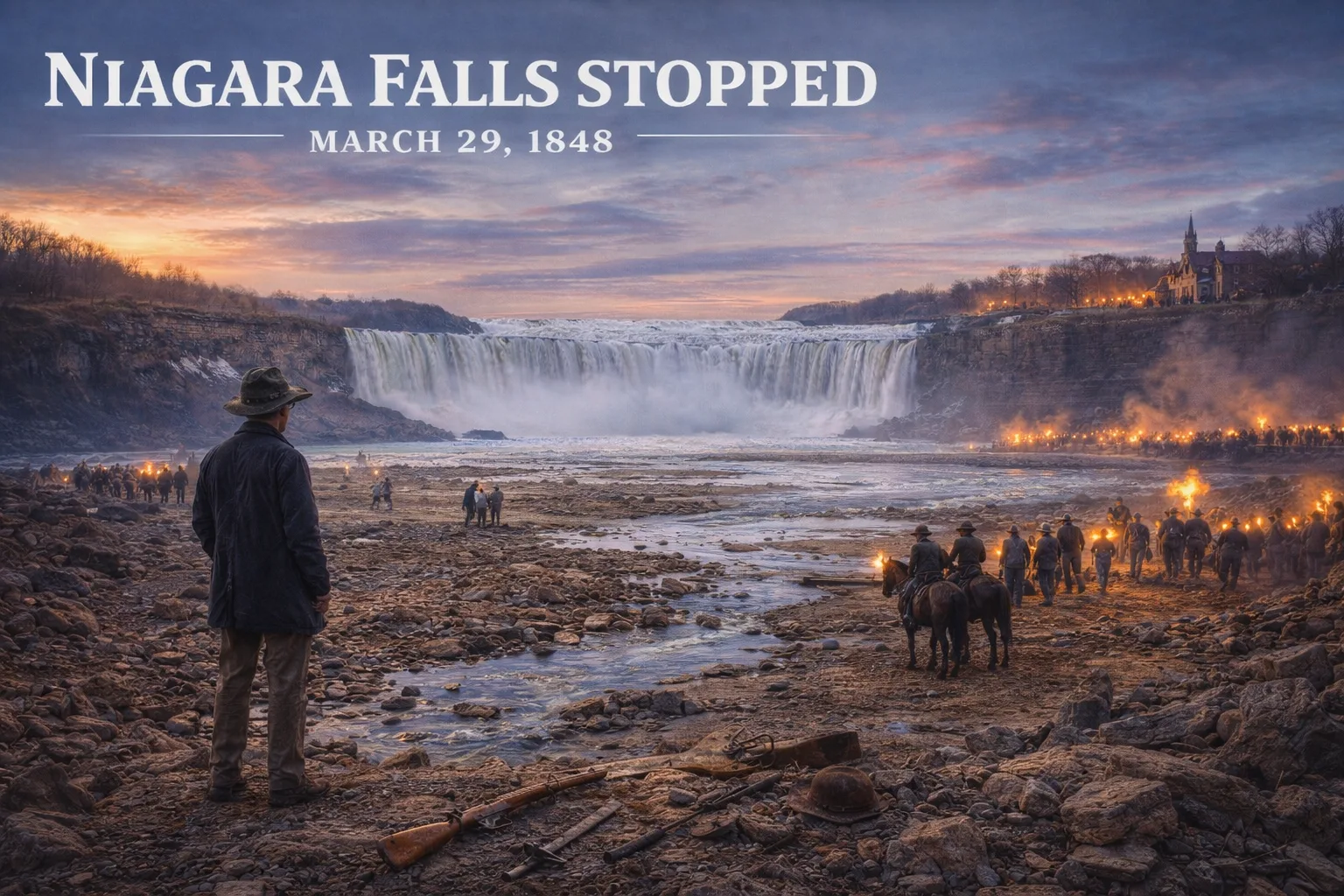
The change in water level began around midnight on March 29. By early morning, residents on both sides of the border could walk across ground that had been under moving water since before any of their ancestors arrived on the continent. The river bottom lay bare in the cold March light, streaked with mud and studded with boulders and the wreckage of more than a century of use.
What People Found Down There
Some people panicked. Churches on both sides of the river held special prayer services. Congregations packed the pews to pray for deliverance from what many believed was a supernatural sign, a divine verdict on the world that had just arrived without warning. A local newspaper reportedly described the scene along the riverbank as one of stunned disbelief and genuine fear.
Other people did what people along the Niagara Frontier have always done, they got practical about it. Souvenir hunters and the simply curious ventured onto the exposed riverbed. What they found there was a kind of accidental archive of the region's violent past. Muskets, bayonets, and swords turned up in the mud, weapons that had almost certainly been lost or discarded during the War of 1812 battles fought along this same stretch of the Niagara River. The Battle of Chippawa in July 1814 had sent men and equipment into this water. More than thirty years later, the river gave some of it back.
Entrepreneurial young men arrived with a logging cart and hauled off large pine timbers they found near Three Sisters Islands, timbers that were forty to sixty feet long and more than twelve inches square. The Maid of the Mist company, whose sightseeing boat had launched just that same year of 1848, sent their workers onto the exposed riverbed with dynamite to blast apart boulders that had been navigation hazards. They were not going to let a once-in-history opportunity go to waste.
On the night of March 30, hundreds of people reportedly lined both the American and Horseshoe Falls carrying lit torches. The U.S. Cavalry rode horses back and forth across the dry riverbed, hooves clattering on exposed rock where the water had been. The scene, lit by torches in the dark, looked like something out of a strange dream.
The Silence Breaks
The ice dam held for roughly thirty hours. Then, on the night of March 31, the wind shifted direction. Instead of pushing ice toward the river mouth, the new winds worked the other way. With a groan and a crack that people described as a sound like the earth splitting open, the dam began to break apart.
What came next was something none of those people had ever experienced. A wall of water, backed up behind the ice dam for more than a day, came crashing down the river channel. Historical accounts describe the roar as shaking the foundations of houses up and down the riverbank. The Niagara River was back, and it was angry about it.
Chunks of ice the size of houses tumbled over the Falls. The gorge below filled with a chaos of ice and froth. Within hours, the river had returned to something close to its normal flow, and the world below the Falls looked entirely different from how it had looked the week before.
Why It Never Happened Again
The ice jam of 1848 was a freak convergence of factors that the region has worked hard to prevent from recurring. In 1964, the United States and Canada jointly installed an ice boom at the mouth of the Niagara River, a floating barrier designed to prevent exactly this kind of ice accumulation. Each year, the boom goes in around December and comes out in April, managing the ice flow so that the river stays open and the Falls keep running.
The Falls were stopped artificially once more, in 1969, when the U.S. Army Corps of Engineers built a cofferdam to divert flow away from the American Falls for geological study. But that was planned and controlled. The 1848 stoppage was nature operating on its own schedule, with no warning and no plan.
Niagara Falls State Park, which opened in July 1885 as the first state park in the nation, sits just a short walk from where Jed Porter heard that impossible silence. The park exists in part because of the movement to protect the Falls from commercial overdevelopment, a movement that gained real urgency once people understood how fragile the whole system could be. If a few days of wind could silence Niagara, what could decades of unchecked industry do?
What It Means for the 716
The story of March 29, 1848 tends to get told as a curiosity, the day Niagara Falls stopped, can you believe it. But there is something deeper here about this region and its relationship with the water that defines it. The Niagara River has been the 716's most consistent neighbor for as long as people have lived here. The Seneca knew it. The French explorers knew it. The mill owners, the hydro engineers, the tourists, the people who grew up hearing that roar from their bedroom windows, they have all built their lives around the assumption that the water does not stop.
For thirty hours in late March 1848, that assumption broke. And the response, the fear, the prayer, the torchlit vigil, the practical men with dynamite and logging carts, was very human and very Western New York. When something impossible happens here, people stand and stare for a minute. Then they figure out how to use it.
Comments
Loading comments...
Leave a Comment