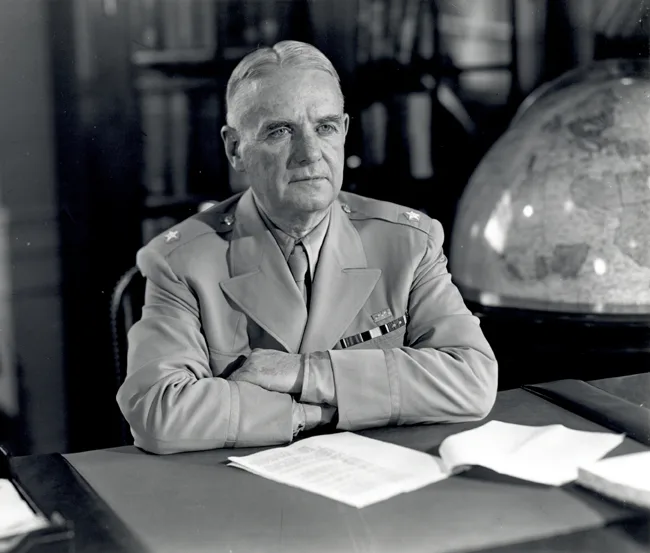
A First Ward Kid Who Changed the World
Before he was the father of American intelligence, before he founded the OSS that became the CIA, before he earned the Medal of Honor and became one of the most decorated soldiers in American history, William Joseph Donovan was just a kid from Buffalo's First Ward. Born on New Year's Day 1883, the son of an Irish immigrant railroad superintendent, he grew up poor and Catholic in a neighborhood where that combination didn't open many doors.
But Donovan was smarter and more ambitious than his circumstances. He made it to Columbia University, played quarterback on the football team, got his law degree, and came back to Buffalo to practice law. Then he married Ruth Rumsey — the daughter of the richest man in the city — and suddenly the kid from the First Ward was sitting in the parlors of Delaware Avenue's most powerful families.
He became the first Catholic ever admitted to the Saturn Club, Buffalo's most exclusive social club. He fought in World War I with the famous Fighting 69th Infantry Regiment, where his soldiers gave him the nickname "Wild Bill" because nobody could keep up with him. He won the Medal of Honor, the Distinguished Service Cross, and came home a national hero. Then, in the early 1920s, President Coolidge's Justice Department sent him back to Buffalo as the U.S. Attorney for Western New York. His job: enforce Prohibition.
The Night He Raided His Own Club
Buffalo in the 1920s was a drinking town that had zero interest in being told to stop. The German beer culture ran deep, the Irish weren't about to give up whiskey, and the Canadian border was right there. Bootleggers had an easy supply chain — Canadian whiskey came across the Niagara River under cover of darkness, and half the waterfront seemed to be in on the game.
Donovan was personally opposed to Prohibition. He thought it was bad law. But he believed the law was the law, and he was going to enforce it regardless of who got caught. On August 23, 1923, at 8:30 in the evening, he sent federal agents with sledgehammers into the Saturn Club. They cracked open the members' private lockers and found at least sixty quarts of whisky, a similar amount of gin, five gallons of moonshine, and bottles of champagne and vermouth scattered throughout.
The names attached to those lockers were some of the most powerful families in Buffalo — Knox, Schoellkopf, Porter, Lockwood. These were Donovan's friends. His peers. The people who had accepted him into their world. And he raided them anyway. His own law partner quit the firm over it. His wife never forgave him. And when he later ran for Governor of New York, many say he lost his hometown at the polls because Buffalo's power brokers still held a grudge about that night at the Saturn Club.
The Fix Brothers Had a System
While Donovan was cracking down on Buffalo's elite, a different kind of bootlegging operation was running just a few miles upriver on Grand Island. The Fix brothers — the same family we wrote about last week — had built something the Feds couldn't easily touch.
Here's what made the Fix brothers nearly untouchable: they owned the ferries. Before 1935, there were no bridges to Grand Island. If you wanted to get there, you rode a boat. And if you were a federal agent heading to the island to raid the Bedell House — the old hotel at the foot of Ferry Road where you could allegedly get whatever you wanted to drink — you were riding a Fix brothers ferry to get there.
Think about that for a second. The bootleggers controlled the only way onto the island. They could see who was boarding. They knew the faces of the agents. And they could get word to shore before the boat even docked. According to the Grand Island Historical Society, the system worked beautifully. One time, federal agents got so excited on the way over that they shouted from the boat, "We have warrants for your arrest!" before they'd even reached the dock. The Fix brothers simply turned the boat around and headed back the other way.
Grand Island was perfect for the operation. The roads were deserted in the early morning hours, making it easy to move Canadian whiskey from hidden spots along the shoreline to waiting trucks. The island had long stretches of riverbank where boats could pull up unseen. And the Fix brothers knew every inch of that water from years of running ferries and excursion boats between Buffalo and the island's hotels.
Two Sides of Prohibition in WNY
What makes this story remarkable is the contrast. On one side of the river, you had Wild Bill Donovan — a decorated war hero, a man of principle, raiding his own friends because he believed in the rule of law. On the other side, you had the Fix brothers — local boys who grew up on the water and used the geography of an island to outsmart the entire federal enforcement apparatus.
Donovan's Prohibition crusade ultimately drove him out of Buffalo. The social elite froze him out, and he moved to Washington, then New York City, where he built a Wall Street law firm and eventually caught the attention of President Roosevelt. During World War II, FDR tapped him to create the Office of Strategic Services — America's first intelligence agency — which later became the CIA. A statue of him stands in the lobby of CIA headquarters in Langley, Virginia today.
The Fix brothers stayed on the island. The bridges opened in 1935, which killed the ferry business, but the family had been part of Grand Island's fabric for generations. Their bootlegging days became the kind of stories that got passed down at kitchen tables and backyard barbecues — the kind of stories that almost get lost if someone doesn't write them down.
The Stories Are Still Out There
This story exists because a 716 Spotlight follower named Doug Saltzman dropped a comment on our Fix Brothers post that stopped us in our tracks. He knew about Wild Bill Donovan. He knew about the Bedell House raids. He knew that the ferry captains controlled who got to the island and could tip off the runners before the Feds even stepped off the boat. That's the kind of history that doesn't show up in textbooks — it shows up in comment sections and family conversations.
The Grand Island Historical Society has been working to preserve these Prohibition-era stories, and their research confirms what Doug shared. But there's so much more out there. If your family has stories about bootlegging, rum-running, or Prohibition on Grand Island or anywhere along the Niagara River, we want to hear them. Drop them in the comments or send us a message. These stories deserve to be told before they're gone.
Comments
Loading comments...
Leave a Comment