It Started With a German Immigrant and a Barrel Organ
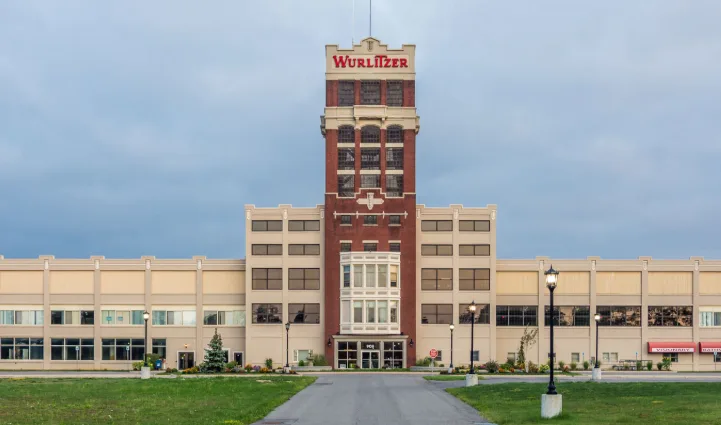
If you drive down Niagara Falls Boulevard in North Tonawanda today, the sprawling brick complex at 908 is hard to miss. The big WURLITZER sign on the side still turns heads. But the story of how that building came to be starts way before Wurlitzer ever showed up.
In 1892, a German immigrant named Eugene de Kleist built the North Tonawanda Barrel Organ Factory on that site, backed by carousel builder Allan Herschell. The timing was perfect. The U.S. government had just slapped heavy import tariffs on European street organs, and American fairground ride manufacturers were desperate for local instruments to attract crowds. De Kleist filled that gap. His factory hummed with the sound of pipes and gears, turning out barrel organs for carnivals and amusement parks across the country.
De Kleist had a relationship with the Wurlitzer family going back years. He was already supplying them with automatic instruments, and in 1908, after de Kleist was elected mayor of North Tonawanda, Wurlitzer bought him out entirely. The youngest Wurlitzer son, Farny, was sent north to run the plant. Farny was 25 years old and full of ideas.
Farny Wurlitzer and the Sound That Filled Every Theater in America
Farny's first big move was bringing in a British inventor named Robert Hope-Jones, an eccentric genius who had spent years revolutionizing pipe organ design. Together, they developed what became known as the "Mighty Wurlitzer" theater organ, and it hit the market at exactly the right moment. Silent movies had arrived, and theater owners needed something to fill the emotional gap that sound couldn't yet provide.
The Mighty Wurlitzer did that and then some. It could imitate drums, cymbals, bird whistles, train whistles, and a full orchestra, all controlled by a single organist sitting at a console in front of a packed house. When it swelled up during a chase scene or went quiet under a love story, audiences felt it in their chests. That sound was built right here in NT, shipped out to theaters from New York to Los Angeles.
Then talking pictures arrived, and almost overnight, the theater organ business evaporated. Farny pivoted. When the Great Depression hit and the company was overextended, he fought to keep the North Tonawanda plant open. In 1934 he struck a deal to manufacture a new automatic phonograph invented by Homer Capehart. That phonograph became the Wurlitzer jukebox, and by the late 1930s the plant was producing over 45,000 of them a year. The iconic glowing jukebox in every diner and soda fountain in America? Made right here.
Three Thousand Workers and a City Built Around Music
At its peak, the Wurlitzer plant on Niagara Falls Boulevard employed 3,000 people. That's not a statistic, that's a neighborhood. Generations of North Tonawanda families had someone who worked there. The building itself kept growing, expanding throughout the early 1900s until it covered roughly 750,000 square feet, including a three-story tower and a massive single-story production floor.
During World War II, the factory shifted to military production, helping develop the variable timing proximity fuze for the U.S. Navy. When the war ended, it went back to jukeboxes, electronic home organs, and other instruments. Farny Wurlitzer ran the North Tonawanda plant until his death in 1972. After that, production wound down fast. By 1975, manufacturing had stopped. By August 1976, Wurlitzer had pulled out entirely.
From Empty Shell to NT Landmark
For years the building sat vacant, deteriorating, slated for demolition. Then in the early 1980s, a group of investors bought the complex and began the slow work of turning it into an industrial park. In 1992, a family purchased the building and committed to rehabilitating it piece by piece. It's been a long road, but today the Wurlitzer complex is alive again.
Walk through it now and you'll find Platters Chocolates, Woodcock Brothers Brewing Company, Fattey Beer Co, Martinsville Soapworks, a catering and wedding venue called Wurlitzer Events, and dozens of other retail, office, and light industrial tenants. The high ceilings, exposed steel beams, oversized windows, and original brick still carry the weight of everything that happened here. The sign on the building still says WURLITZER, and NT wouldn't have it any other way.
Comments
Loading comments...
Leave a Comment